Charlotte  Haenlein
  • Home
  • Patchwork & Quilting
    • Patchwork Quilting Overview
    • C&G Medal for Excellence
    • Exhibition at Festival of Quilts 2015
    • Exhibition at Festival of Quilts 2016
    • Article in The Quilter, Winter 2016
    • Patchwork Quilting Teaching
  • Silk Painting
    • Silk Painting Overview
    • Silk Painting Teaching
    • Artweeks Exhibitions
    • Silk Painting Photo Galleries >
      • Hangings
      • Scarves
      • Screen Dividers
      • Wearables & Accessories
      • Nursery Friezes
  • Educational Work
    • Overview
    • Ashmolean Museum Oxford, Community Project
    • Campsfield House Immigration Detention Centre Oxford
    • Community English School, Oxford
    • Family Learning Projects, Oxford
    • High Wycombe Green Street School ESOL Literacy Project
    • Homeless Project, Oxford
    • Sandwell College, Birmingham
    • Silk Painting Course, East Oxford
    • Wallingford Teen Mums Project
  • English Teaching
  • Contact
  • Untitled
  • Home
  • Patchwork & Quilting
    • Patchwork Quilting Overview
    • C&G Medal for Excellence
    • Exhibition at Festival of Quilts 2015
    • Exhibition at Festival of Quilts 2016
    • Article in The Quilter, Winter 2016
    • Patchwork Quilting Teaching
  • Silk Painting
    • Silk Painting Overview
    • Silk Painting Teaching
    • Artweeks Exhibitions
    • Silk Painting Photo Galleries >
      • Hangings
      • Scarves
      • Screen Dividers
      • Wearables & Accessories
      • Nursery Friezes
  • Educational Work
    • Overview
    • Ashmolean Museum Oxford, Community Project
    • Campsfield House Immigration Detention Centre Oxford
    • Community English School, Oxford
    • Family Learning Projects, Oxford
    • High Wycombe Green Street School ESOL Literacy Project
    • Homeless Project, Oxford
    • Sandwell College, Birmingham
    • Silk Painting Course, East Oxford
    • Wallingford Teen Mums Project
  • English Teaching
  • Contact
  • Untitled

Silk Painting

My love affair with silk started in 1980, on my first visit to India. On my return I immediately set out to learn the many different skills of silk painting  . . .  and I'm still as enthusiastic about this versatile craft as I was on day one!
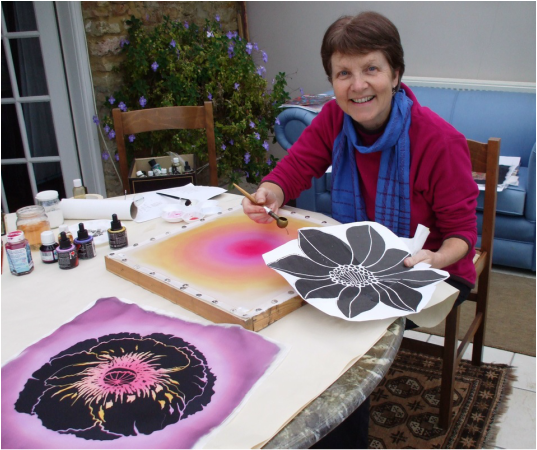
I have since taught silk painting in a wide variety of settings to adults as well as children (see Educational Work), and have experimented with many techniques (see Silk Painting Photo Galleries). More recently my City&Guilds qualification in Patchwork&Quilting has given me the confidence to take silk painting further and explore exciting new ground (see Patchwork & Quilting).​

Picture

Silk painting is a fluid craft with few predetermined outcomes, so it offers endless scope for improvisation and colour play. The use of wax resists is perhaps my favourite technique. But I also enjoy the challenge of free-flow 
​techniques and creating texture through salting. More recently I have developed an interest in silk applique, and in making silk painted /printed wearables. Also,  combinations of quilting and painting in Inktense fabric blocks have opened up new avenues which I'm keen to explore in the future.
​​

​In praise of silk​
​​

 Silk has many qualities which sets it apart from other fibres:

  • Silk is strong. It is finer than human hair yet it is as strong as an iron wire of the same diameter.
  • Silk is lustrous. It reflects light. This is caused by the silk filament starting as a semi liquid and solidifying as it makes contact with the air.
  • Silk is translucent.The shimmering appearance of silk is due to the triangular prism-like structure of the silk fibre, which allows silk cloth to refract incoming light at different angles, thus producing different colors.
  • Silk dyes well.  Silk fibres, being proteins in nature, have good absorbency, and thus good affinity for dyes. 
  • Silk is elastic. It can stretch by 10% to 20% without breaking. 
  • Silk fabric breathes and has warmth without weight. It is luxuriously soft to touch and wear: cooling in summer and comforting in winter. 
  • Silk comes in a breathtaking range of textures and can be combined with many other fibres. 
  • ​Silk is precious. It is a slow and difficult process to produce silk fibre.  
  • Silk is expensive. Around 12  kilos of cocoons will only produce about 1 kilo of reelable silk (long fibres) and 1  kilo of unreelable spinning silk (short fibres).  
  • Silk is labour intensive. To produce 1 kg of silk, 104 kg of mulberry leaves must be eaten by 3000 silkworms. For example, it takes about 5000 silkworms to make one pure silk kimono.
 

GALLERY
Proudly powered by Weebly
Picture